

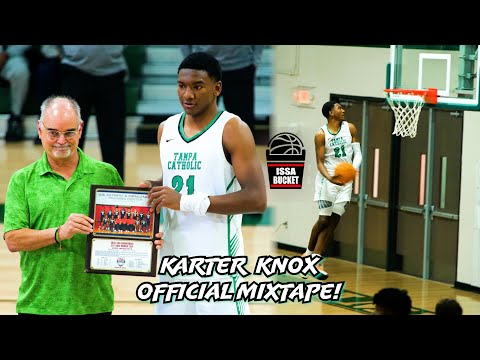
Karter Knox spent a lot of 2023 running up and down the court for Tampa Catholic High School, slamming home highlight reel dunks while averaging almost 20 points and 10 assists a game. Knox, a six-foot five-inch, 230-pound guard, was building on a family legacy at TC, started by his older brother Kevin Knox, Jr., who launched his own NBA career at TC just seven years prior.
Karter, a McDonald’s All-American, would soon receive lucrative NIL endorsement opportunities from apparel giants Fanatics and Adidas for his stand-out play at TC.
The only problem was that Florida law did not allow high school athletes to engage in NIL agreements, forcing Karter into a life-altering decision: to stay at Tampa Catholic and reject a life-changing amount of money or move to a state that did.
Knox chose the latter, accepting the agreements and transferring to Overtime Elite in Atlanta, Georgia, to play his senior year.
Unlike Knox, Florida’s high school athletes will no longer have to make that choice. On June 6, the Sunshine State became the 36th in the country to allow high school athletes to profit from their name, image, and likeness (NIL).
The once-controversial idea was unanimously passed by the Florida High School Athletic Association (FHSAA) and is expected to be ratified when the Florida Board of Education meets on July 24.
“If they’re not competing with NIL, they (Florida) will lose opportunities. It was a forced hand,” Jake O’Donnell, the founder and CEO of EAMG Sports agency, told Creative Loafing Tampa Bay. “Unless Florida wants to lose its athletes to move across the country to Texas, Ohio, or California, they must be willing to compete.”
O’Donnell believes that the impact of the new bylaws will go deeper than offering student-athletes a quick payday. “This is an opportunity for high school athletes to build a personal brand and monetize it without jeopardizing their eligibility,” he added.
High school coaches, athletes, and parents across Florida have agreed with O’Donnell, with some industry experts going even further, saying Florida now holds unique recruiting advantages over other states.
Related

Florida will allow high school athletes to benefit financially from name, image and likeness
Dave Meluni, an Associate Teaching Professor at Syracuse University in the Falk College of Sport, believes the new bylaws will turn Florida into a recruitment powerhouse.
“I actually think Florida has an advantage that you may see kids from other states come in because there may be better opportunities for NIL in the state of Florida,” Meluni told CL.
Meluni also points to Florida high schools that have top-tier athletics, like IMG Academy, along with flourishing media markets, as reasons Florida will attract transfer athletes.
“You could be a potential student-athlete in Alabama and not have an opportunity,” Meluni said. “But look at the markets of Orlando, Tampa, St. Pete, Miami, Jacksonville.”
Don Dziagwa, the Head Basketball Coach and athletic director for Tampa Catholic High School argued that this change was overdue.
“I think the NIL thing is a year too late for me. I would have loved to have the player (Knox) stay with us and play his senior year here,” Dziagwa said.

Knox’s father, Kevin Knox Sr., a retired NFL wide receiver, told CL the NIL opportunities from Fanatics and Adidas were too good for his son to pass up and did serve as a driving force in his son’s decision to transfer to Overtime in Georgia.
“We kind of looked at it as a great opportunity for Karter, the start of his career, and financially, to give him an opportunity to get ahead in life,” Knox Sr. said. “That opportunity was not offered to us in Florida.”
Knox’s case is not unique. Had it not approved NIL, Florida risked forcing high school athletes to reject lucrative opportunities or enter the transfer portal and continue their careers out of state.
The high school transfer portal is a system that allows student-athletes to transfer schools freely without having to sit out a season or lose a year of eligibility.
The bylaws do bring risks. Meluni said NIL agreements have often welcomed boosters to engage in pay-for-play. He warns that the promise of NIL—to allow high school athletes to begin building a personal brand without the risk of punishment—is often lost in its practical translation.
“I do not like the word NIL because it’s turned into pay-for-play, right?” Meluni told CL. “I love the idea of NIL, but NIL is the opportunity to monetize your name, image, and likeness, which by the NCAA defined as your right of publicity, and I define it as your athlete marketability.”
Meluni warns that these ideals are at risk if boosters seek to engage in quid-pro-quo agreements with student-athletes and their families, clouding the NIL space.
“If you’ve ever seen the show or the movie ‘Friday Night Lights’ in Texas, where the Buddy Garrity’s of the world owns a car dealership, and he slides somebody an envelope for cash to come play at that school,” Meluni told CL. “The reality of this is that it’s athlete marketability and right of publicity, where that student-athlete can use their name their, their likeness. or their likeness.”
The FHSAA did include a series of provisions meant to protect student-athletes, including rules against engaging with collectives and boosters, as well as banning the promotion of drug use, firearms, or narcotics. Student-athletes are also prohibited from using any school-copyrighted items in NIL promotions.
The FHSAA and the Florida Board of Education declined CL’s request for comment.
Most people involved in Florida high school sports, like Dziagwa, support the new bylaws. “I think those are fantastic situations for kids to have people wanting to pay them money because of their name, image, and likeness. I see no problem with that,” he said.
Knox Sr. agrees.
“How young is too young?,” he told CL. “We live in America, the Land of the Free. Right?”
Subscribe to Creative Loafing newsletters.
Follow us: Google News | NewsBreak | Reddit | Instagram | Facebook | Twitter
This article appears in Jul 11-17, 2024.
