
Author Michael Lewis has become the great chronicler of modern America's twin obsessions of sports and finance. Whether he's talking about the 2008 economic collapse (The Big Short), geniuses of silicon valley (The New New Thing) or the evolution of the game of football (The Blind Side), Lewis centers his non-fiction on smart people who attain some insight, attempt to use it in the real world and are met with entrenched ignorance at every step. Lewis's Moneyball delved into the world of professional baseball, and chronicled Oakland general manager Billy Beane and his embrace of something called "Sabremetrics," a system of statistical analysis that allowed small-market clubs like the A's to compete with wealthy Goliaths like the Yankees. The book is detailed, meticulous and fascinating. It's no wonder they never quite figured out how to make it into a movie.
Moneyball was something of a troubled production, with original director David Frankel replaced by Stephen Soderbergh, who bolted to make Contagion when studio heads reportedly balked at his using interviews with the real-life players in the film. Capote's Bennett Miller took it from there, working from a script that originated with Stan Chervin, but was rewritten by both Aaron Sorkin (The Social Network) and Steve Zaillian (Schindler's List). The resulting film sticks closely to the arc of the book while never achieving its richness — a common complaint about non-fiction adaptations, to be sure. But without that richness, all that's left is a standard sports movie with an unsatisfying ending.
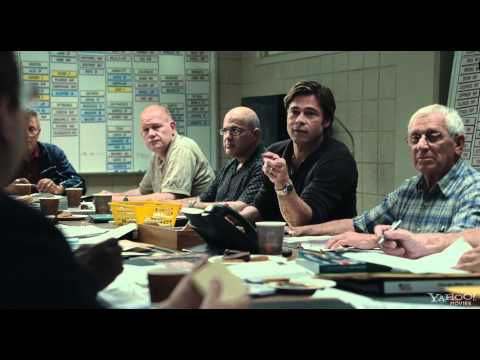
The film tracks the Oakland A's from the conclusion of the 2001 season, when the team lost to the Yankees in the playoffs before losing its best players to free agency, through the team's 2002 season, which starts horribly before turning around in spectacular, record-breaking fashion. At the center of the film is Billy Beane, played by Brad Pitt as a man with a palpable disgust for losing. Facing another off-season of sitting around a table with the oldster scouts (all 65 years and up) as they evaluate talent they'll never be able to afford, Beane knows that they have to think differently if they want to compete with the big-money teams.
On a trip to Cleveland, Beane meets Peter Brand (Jonah Hill), a wet-behind-the-ears Yale grad with inordinate sway among the Indians' top brass. Why are they listening to this kid? Beane wants to know. Brand is a number cruncher, a guy who creates spreadsheets that reduce wins and losses to mathematical equations involving runs, walks and on-base percentages. Beane hires the kid away, and together they turn the A's into a baseball laboratory — pissing off the entrenched scouts, ownership, fans and players in the process.
Strong resistance comes from team manager Art Howe (Philip Seymour Hoffman), who balks at Beane's repeated requests to play specific players. No problem; the GM simply trades away the manager's favorites — including future Rays star Carlos Peña. (The scenes with Pitt and Hill working over other GMs on the phone are some of the best in the movie.) Howe simply can't buy into the idea that a roster made up of guys that have bizarre fundamental mechanics, or are past their prime, or worse yet, are dealing with lingering injuries, can win games. But the math says it will happen, and before long it does.
But only up to a point. Baseball fans know how this story turns out (if you want to be surprised, skip to the next paragraph). The A's win 20 games in a row during the 2002 regular season — shattering a nearly century-old record in the process — but get bounced from the playoffs by the Minnesota Twins. And in our win-at-all-costs culture, doesn't that make Beane a loser? Moneyball attempts to fashion a "happy" ending out of Beane getting a huge offer from the Boston Red Sox to become the highest-paid GM in baseball, but Beane turns it down and the Sox end up breaking the curse of the Bambino without him. What's the audience supposed to take away from this, other than it's better to be the second guy, not the first, to profit from a big idea?
Brad Pitt is terrific as Billy Beane. Sporting the worst haircut of his career, constantly (and disgustingly) spitting chew into a cup and looking more weary and disheveled than ever (yet still mind-numbingly handsome), Pitt is on screen the whole time and it's his charisma that makes Moneyball float. Pitt's repartee with Jonah Hill (still chubby here, and showing some dramatic chops) is the highlight of the film, and anytime the two get a scene together it's a good one. But aside from Pitt and Hill, the rest of the cast is forced to make due with underwritten or non-existent roles.
My advice: Stick with the written word. Moneyball the book is a home run and a must-read for baseball fans. Moneyball the movie is more like a broken bat infield single — effective but uninspiring.
This article appears in Sep 22-28, 2011.