Should a new Tampa Bay Rays stadium be a publicly-traded company? Could we all be its “shareholders”? One Tampa mayoral candidate thinks so.
Taryn Sabia—an urban designer, educator, and community advocate—has proposed creating a Tampa Bay Regional Stadium Entity as an alternative to a traditional stadium subsidy model. Her proposal is conceptual, not a finalized financing package, but it attempts to answer a question that has dogged stadium deals for decades: if the public is expected to participate financially, should the public also share in the upside?
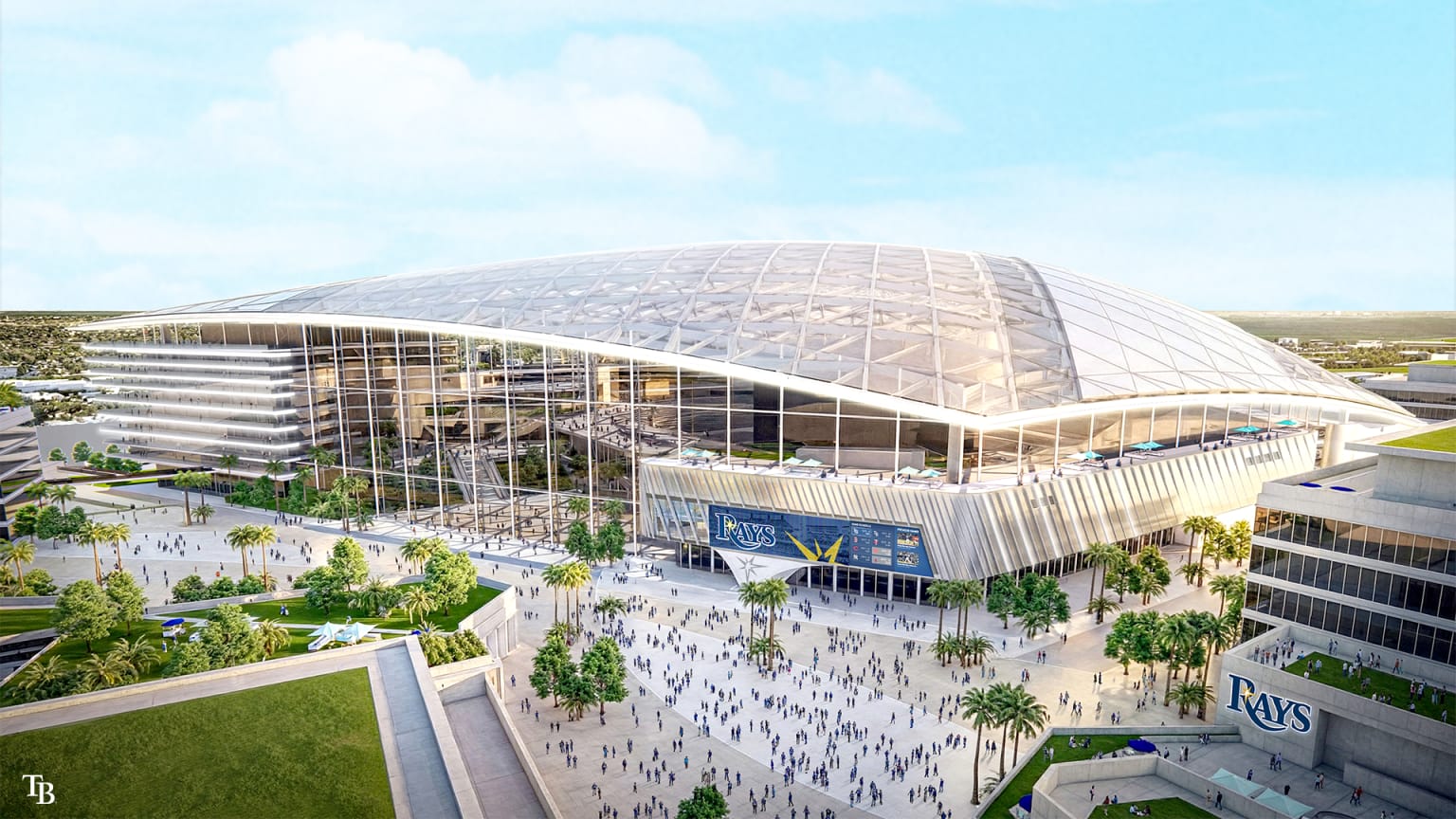
The question comes as the Tampa Bay Rays announced that city and county officials have arrived at a non-binding memorandum of understanding (MOU) regarding the $2.3 billion decision to build a new baseball stadium in Tampa’s Drew Park area on the land currently occupied by Hillsborough College. The deal also hinges on $150 million from the State of Florida to rebuild the campus on a smaller footprint.
The MOU—which Rays CEO Ken Babby “respectfully but resolutely” encouraged officials to approve—would place the new stadium within an existing sports district, near Raymond James Stadium and Legends Field, with access to Tampa International Airport and the Howard Frankland Bridge. But questions remain about who should pay for each piece of the plan, which public funding sources should be used, and who benefits if the surrounding district grows in value.
Hillsborough County Commissioners approved the non-binding MOU in a 5-2 vote on May 20 with Commissioners Donna Cameron Cepeda and Joshua Wostal voting no. On May 21, Tampa City Councilmembers approved the MOU in a 4-3 vote, with Councilmembers Lynn Hurtak, a mayoral candidate herself, Charlie Miranda, and Guido Maniscalco voting now. While District 4 Councilman Bill Carlson—another mayoral candidate—voted yes in chambers, he told the Tampa Monitor he “would vote no on the final deal.”
In a social media post after the vote, Hurtak defended her rejection of the MOU, alluding to the argument that voters did not foresee taxes going towards stadiums when they approved the half-cent community investment tax in 2024. “Now the Rays are asking for 80 million of your tax dollars to go toward a stadium instead of police cars, fire trucks, road resurfacing, and park improvements. I promise that, as your mayor, I will continue to use your tax dollars wisely,” she added.
Sabia’s proposal goes into more depth.

“The burden of funding a regional asset shouldn’t be borne by the taxpayers of a single municipality. The Tampa Bay Rays and a new stadium for them to play in should reflect regional risk and burden, and regional share in the spoils of their success,” Sabia said.
Sabia’s plan would reduce reliance on public funds, reserving tax dollars for surrounding infrastructure only, like sidewalks, lighting, and stormwater upgrades, not the stadium itself. Sabia mentioned that the tax revenue upside powering the optimistic projections for the broader Drew Park area may be years or decades away, contrasted against Water Street, which had financing mechanisms built in upfront.
Sabia said the stadium debate too often gets framed as a binary choice. Her proposal, she said, is an attempt to ask a different question: if residents want the Rays to stay in the area, but don’t want CIT dollars used for a stadium (citing a poll commissioned by a member of the Tampa Sports Authority), what other ownership and financing models are available?
Under Sabia’s concept, the entity would blend public and private funding for construction, operations and maintenance. But unlike the Rays’ current proposal, it would split stadium ownership between the Rays, with 51%, and various public investors, with 49%. That public share would include 25% reserved for individual residents of the region’s eight counties.
Sabia argues that a publicly traded stadium corporation would require greater transparency from Major League Baseball and Rays leadership, broader public participation in decisions, and shared dividends from stadium revenues.
She points to examples outside the traditional subsidy model, including the community-owned Green Bay Packers, publicly traded Madison Square Garden Sports, and publicly-traded Atlanta Braves Holdings, which includes the Braves and The Battery Atlanta mixed-use district. The Green Bay Packers are an anomaly, having been grandfathered in—an arrangement the NFL wouldn’t allow today.
Alan Clendenin, chair of the Hillsborough County Democratic Party and a supporter of the current framework, said the existing proposal already addresses some of the ownership concerns raised by Sabia. He told Creative Loafing the Rays ownership group is committed to paying 55% of the stadium cost, including overruns and maintenance, while Hillsborough County would own the stadium asset.
Others have taken issue with the use of public funds to build a new stadium for the Rays—including Tampa City Councilmember Hurtak. She called Sabia’s plan “a very academic proposal,” and questioned whether Major League Baseball would be willing to open its finances to the public.
Hurtak also emphasized that, under the current framework as she understands it, the City would not pay directly for the stadium itself, but for surrounding infrastructure, most of which would come from CRA dollars that are limited to horizontal infrastructure.
Across Dale Mabry Highway from the proposed Rays site sits the Tampa Bay Bucs’ Raymond James Stadium, built in 1998 and paid for by the CIT. That sales tax referendum initially failed, but passed in 1996 after a second attempt with the addition of a new Bucs stadium as part of its scope. Today, that facility is owned by the Tampa Sports Authority and shares non-game revenue with both the city and county. The CIT was renewed in November 2024 and did not include any language about using funds for a new stadium.
That distinction gets to the center of the debate: should public funds be used to support new sports facilities? And if so, which parts should they pay for, and how should any profits or long-term gains be shared?
Tampa mayoral candidate and local food critic Anthony Gilbert, known by his social media handle @callanthony_, said Sabia’s concept is interesting because it changes the public’s role in the deal.
“I think [Sabia’s] concept is interesting because it shifts the conversation from taxpayers simply funding projects to residents potentially having a level of ownership and long-term benefit from developments that shape our region,” Gilbert told Creative Loafing.
But Gilbert said any shared ownership model would need clear pathways for working-class and lower-income residents to participate, not just large investors or corporations.
“One of the biggest questions I would have is how this model would truly include working class and lower income residents,” Gilbert said. He said that could mean affordable shares, community investment programs, local hiring guarantees, neighborhood reinvestment funds or revenue-sharing models.
“I’m most definitely opposed to using CIT money to fund it,” Gilbert said, arguing that sales taxes place a heavier burden on lower-income residents when public dollars are diverted from core needs.
For Sabia, the stadium debate is a symptom of a deeper problem: a region that keeps recycling the same arguments about development, transit, and housing without ever changing the underlying question. Her proposal, she says, is less about baseball than about what it looks like to finally ask something different.
Pitch in to help make the Tampa Bay Journalism Project a success.
Subscribe to Creative Loafing newsletters.
Follow us: Google News | NewsBreak | Reddit | Instagram | Facebook | BlueSky
This article appears in May 21 – 27, 2026.